Wild Water World Beginner's Guide: Build the Raft Before You Explore
An opening plan for Wild Water World: secure water and food, treat diving as a capacity test, and expand the raft only when production keeps up.
Wild Water World opens with the modern world already gone. The store listing describes a flooded planet, a family that survived, and a raft that is the only ground left. The game then asks you to do two things at once: keep the raft livable and push outward into open water.
New players usually pick exploring first. That is the expensive choice. Distance costs supplies, and supplies are produced by a raft that has to be working before you leave it.
The current build is version 1.2.3, updated 23 September 2026, published by Hong Kong Just Game Technology Limited. The iOS listing holds 4.6 out of 5 from about 1,050 ratings, and the global release covers more than 150 countries, so the English build is the one most players will meet.
The raft is a production line, not a vehicle
Every upgrade decision comes down to one question: does this make the raft produce more of what keeps people alive? Food and fresh water are consumed continuously. Storage determines how long you can be away. Space determines what you can build at all.
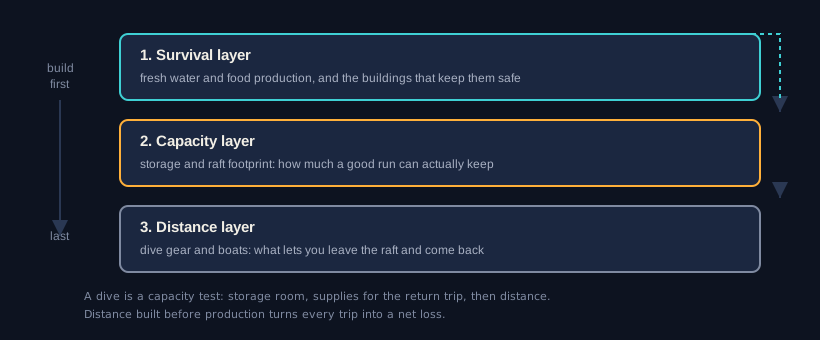
Treat the raft as three layers:
- Survival layer: food and water production, plus the buildings that keep them clean and safe.
- Capacity layer: storage and the raft footprint itself, which decides how much of everything you can hold.
- Distance layer: diving gear, boats, and anything that lets you travel further from the raft.
Build downward through that list. A bigger footprint with no production is a floating storage problem; production with no storage means you throw away half of every good run.
Fresh water first, food second, storage third
Fresh water is the resource that punishes you fastest. When it runs out, everything else stops mattering. Make sure water is always being produced, always stored, and never consumed faster than it is made.
Food is next, but it is more forgiving because it usually comes from multiple sources and can be banked longer. Once water is stable, invest in the food source with the best yield per worker rather than the one that looks most interesting.
Storage comes third, and it is the upgrade most players skip. Storage is what converts a lucky dive into a permanent gain. Without capacity, a good run of salvage is wasted because you cannot hold it.
Diving is a capacity test, not a skill test
Diving reads like an exploration feature. In practice it is a test of three numbers: how long you can stay under, how much you can carry, and whether you can get back before something goes wrong.
Before every dive, check the same three things:
- Is there room in storage for the salvage?
- Is the return trip affordable in supplies?
- Is there a reason to go now instead of after the next raft upgrade?
If the answer to any of those is no, the dive is a waste of supplies. Salvage you cannot store is worse than no salvage, because it consumed the trip.
Expand the footprint only when production keeps up
The raft footprint is the most tempting upgrade in the game because it visibly grows your base. It is also the one that most often stalls an account.
Before adding a footprint expansion, confirm that your current buildings are already running at the capacity the last expansion created. If half your build slots are empty or underproducing, more space does not help. It just spreads the same workers across more tiles.
The safe rhythm is: fill the current space, stabilize production, then expand. Not the other way around.
Diagnose the wall instead of buying everything
When progress stops, do not buy the next shiny upgrade. Identify what actually stopped you:
- Supplies ran out during a dive? The problem is storage or production, not gear.
- Could not reach the next area? The problem is distance equipment, and it needs supplies behind it.
- Raft cannot hold the haul? Storage.
- Everyone is sick or unhappy? The survival layer, not the distance layer.
Change one major thing at a time, repeat the same activity, and keep what gives a consistent result. A single lucky run is not evidence that an upgrade works.
What to ignore in the first week
Cosmetic decoration, side systems that do not touch food, water or storage, and any upgrade whose only benefit is convenience. This game rewards queue discipline. The players who pull ahead convert every hour of production into the next meaningful unlock, instead of splitting resources across five systems that each almost work.
FAQ
Is it better to explore or upgrade first?
Upgrade first. The raft produces the supplies that exploring consumes. Until water, food and storage are stable, exploration is a net loss.
How do I decide between a bigger raft and better buildings?
Check whether your existing slots are full and productive. If they are not, improve the buildings. If they are, expand.
Should I dive as soon as diving unlocks?
Only when you have storage room and enough supplies for the return trip. Otherwise wait one upgrade cycle.
Does the game require spending to progress?
The listing does not present itself as pay-gated, and the core loop of production, storage and diving is available to free players. Progress will be slower, but the bottleneck analysis above is the same for every account.
How this page was checked
Written for Mini Game Guides and last verified on Oct 23, 2026. Store names, release dates and platform availability were checked against the official listing; gameplay advice is based on the mechanics described on that listing and the sources below. If a code or a reward is not confirmed, it is not printed.
Spotted something outdated? Tell us with the page URL and what changed.