Whiteout Survival Beginner's Guide: Furnace First, Everything Else Later
A first-week plan for Whiteout Survival: why the furnace sets your ceiling, how to keep heat and survivors working, and when troops and heroes are worth the resources.
Whiteout Survival is a city builder where the city is losing a fight against the weather. Every system in the game is chained to one number, the furnace level, and every beginner mistake traces back to spending resources on something the furnace does not need yet.
The current build is version 1.34.16, updated 20 October 2026, published by Century Games. The iOS listing sits at 4.6 out of 5 from roughly 470,000 ratings, and the iOS, Android and PC clients share account systems, so anything you learn here transfers between devices.
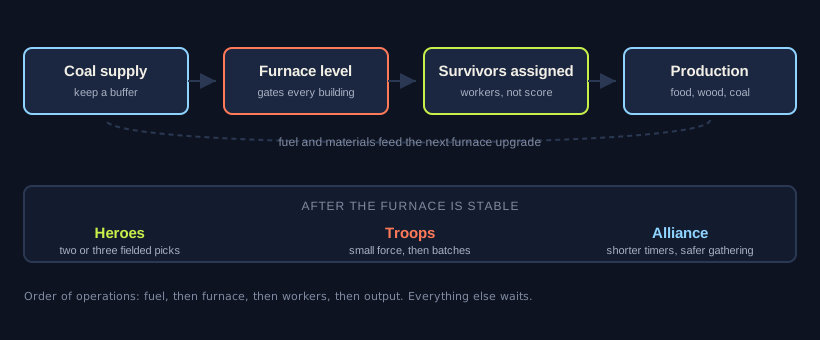
The furnace is your actual level
Other city builders let you level buildings in whatever order you like. Whiteout Survival does not. The furnace level caps your other buildings, unlocks the next tier of content and decides which survival systems you can even see. A level-15 furnace with tidy side buildings will out-progress a level-13 furnace with expensive decorations every time.
So the opening question is never "what can I upgrade?" It is "what does the furnace need?" That breaks into three jobs:
- Gather the materials the next furnace level requires.
- Keep heat production and fuel supply ahead of the survivor count.
- Upgrade only the buildings that either unlock a furnace requirement or fix a bottleneck in food, wood or coal.
Everything else can wait. Buildings that produce nothing you currently lack are a distraction that costs resources you will want back later.
Heat is a resource with a warning light
Coal keeps the furnace burning, and the furnace keeps survivors alive. When heat drops below what the population needs, productivity falls and you start losing the thing you can least afford to lose: time.
Two habits prevent almost every early heat crisis:
- Assign survivors to coal before anything else. A city with full lumber yards and an empty coal store is a city that is about to freeze.
- Keep a coal buffer. Do not spend the fuel reserve down to zero just because a building upgrade became available. The buffer is what carries you through the hours you are offline.
If your heat warning appears regularly, the problem is not the furnace level. It is the ratio of coal income to survivor count, and the fix is either more coal workers or fewer mouths to feed.
Survivors are workers, not a score
Population feels like progress, and it is, but each survivor also consumes food and heat. The useful question is whether every survivor is assigned to a building that produces something the furnace needs next.
Check the assignment screen after every building upgrade. New slots open and old assignments become inefficient. An idle survivor produces nothing while still consuming, which is the worst possible combination.
When you unlock a new production building, move workers into it rather than recruiting more people. Adding population to fix a production problem usually creates a food problem instead.
Heroes: concentrate, do not collect
Hero shards arrive from exploration, events and alliance activities. The temptation is to spread them across every hero you own so that each one is "usable." That produces a roster of mediocre heroes.
Pick a small number of heroes whose role you actually need, usually one damage dealer and one support or crowd-control pick, and push those. A hero with levels and gear does more for your marches than four heroes with neither.
Hero gear follows the same rule. Upgrade the pieces worn by heroes you field, not the pieces that happen to be cheapest.
Troops after the furnace, not before
Training troops early feels productive because the numbers go up, but troops cost resources, food upkeep and hospital space when they get wounded. Before your furnace supports the economy behind an army, a large troop count is a liability disguised as power.
The pattern that works: keep a small force for gathering and events, finish the furnace and economy upgrades that gate your next tier, then train in larger batches. When you do train, train one troop type toward the role you need rather than splitting evenly across every type.
Join an alliance on day one
Alliance membership is not a social nicety in this genre; it is an economic multiplier. Alliance help shortens construction and research timers, alliance territory gives safer gathering, and alliance events pay out resources you cannot easily earn alone.
Join the strongest active alliance you can get into, even if your power is below their average. Activity matters more than your current number, and an alliance that helps timers all day will fix your early economy faster than any single upgrade.
The first-week checklist
- Furnace: always the next major upgrade you are working toward.
- Coal: never let the store drop below a working buffer.
- Survivors: every one assigned, reassigned after each upgrade.
- Heroes: shards concentrated on two or three fielded picks.
- Troops: small force for gathering, no mass training yet.
- Alliance: joined, help requested on every long timer.
- Map: gathering runs inside alliance territory when possible.
- Events: participate for shards and speed-ups, not for rank.
FAQ
Should I upgrade decorations and city cosmetics early?
No. They do not advance the furnace and they consume resources that the furnace chain needs. Save cosmetic spending for after your economy is stable.
What do I do when heat keeps dropping?
Increase coal worker assignments and reduce unnecessary population growth. The furnace level is rarely the cause; the coal-to-survivor ratio usually is.
Is it worth training a big army in the first week?
Only enough for gathering and event participation. Mass training before the furnace supports the food and hospital economy drains resources you need for the next tier.
Which server or state should I start on?
The newest state with an active alliance you can join. Older states have established players and less room in the events that pay new accounts the most.
How this page was checked
Written for Mini Game Guides and last verified on Oct 23, 2026. Store names, release dates and platform availability were checked against the official listing; gameplay advice is based on the mechanics described on that listing and the sources below. If a code or a reward is not confirmed, it is not printed.
Spotted something outdated? Tell us with the page URL and what changed.