Evo Defense: Merge TD Beginner's Guide: Summon vs Merge
How a three-minute Evo Defense run works: fill the board before merging, treat 2-in-1 as a reroll, and upgrade account systems in the right order.
Your first three-minute run is not a luck test. It is a test of whether you fill the board before you merge. Players who merge early end up with one strong unit, five empty tiles, and a wave that walks past the strong unit.
Evo Defense compresses a tower-defense run into about three minutes. That speed is why the decision order matters more than any single hero: you have time for roughly one bad merge, not three.
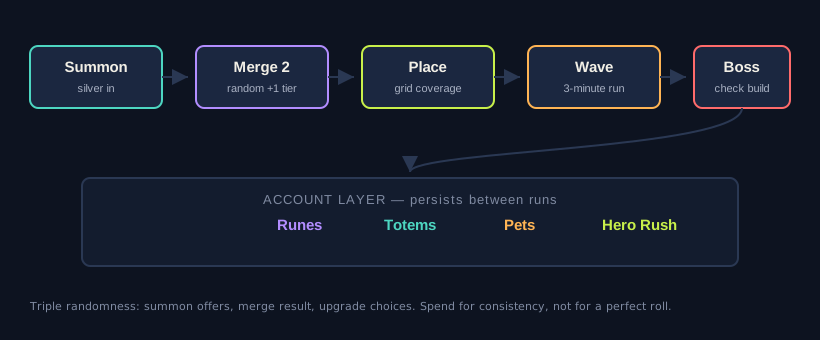
One run, three systems
A run is summon, merge, enhance. Silver is the only in-run currency, and it buys both summons and enhancements, so every purchase trades against the other.
The game describes its randomness as triple: random summons, random enhancement choices, and random 2-in-1 merge results. On top of that sits the account layer, which the launch material lists as King, Heroes, Weapon, Totem, Cloak, and Fort. Seven hero classes fill the board: Archer, Support, Mage, Controller, Warrior, Summoner, and Poisoner.
The run layer decides whether you survive this wave. The account layer decides how high a wave you can survive at all. Do not confuse the two.
Fill the board before you merge
An empty tile is zero damage. A level-one unit on that tile is some damage, some blocking, and a merge ingredient for later. A full board of level-one units usually beats one level-two unit surrounded by gaps.
So the opening rule is simple: summon until most slots are covered, then consider merging. The BlueStacks strategy guide puts it the same way, and adds that merging while slots are empty is the most common mistake.
Once the board is covered, decide what the wave needs. If enemies are breaking through, summon more bodies. If the board holds comfortably, buy enhancements. Summoning is stabilization; enhancements are optimization.
The 2-in-1 merge is a reroll
Merging two units of the same level produces a random higher-tier unit from your loadout. You do not choose the result. That makes merging a reroll of your board, not a straight upgrade of the unit you fed into it.
Three rules follow.
Do not merge your only copy of a critical role. If you have one Controller and the wave is fast, merging it can remove the only thing slowing the wave.
Merge duplicates of low-impact units first. Two extra Warriors are safe fodder; your single Archer is not.
Do not merge during a boss wave. The temporary dip in board strength is exactly when a boss walks through. Merge between waves, not inside them.
If the merge result is bad, you have lost a unit and gained a worse one. That is the cost of the system, and it is why you should keep merges low until the board has redundancy.
When to stop merging and place
Stop when the board is full, every job is covered, and the next merge would remove a role rather than duplicate it. At that point, silver goes into enhancements that match what is already on the board.
Placement still matters even though the game is one-handed and fast. Long-range units, especially Archers, benefit from sitting far from the fort. Higher-tier units should sit on the tiles that give bonuses, not on the first empty square. Put your control units where the path bends, so enemies stay in range longer.
If a wave reaches the fort, move damage toward the entrance before you buy more damage. Position is free; upgrades are not.
Account systems in priority order
The account layer is where beginners spread resources too thin. Use this order.
- Hero Rush and your hero roster. Job: board ceiling. A roster with one reliable damage hero and one control hero changes every run. Pull for breadth before depth, and use the tier list to check roles rather than rarity.
- Totems. Job: permanent run buffs. They apply across modes, so upgrade the ones that match your main damage class instead of raising every totem a little.
- Runes. Job: closing small stat gaps. They are incremental, so spend here when a run fails by a narrow margin, not when it fails at the first wave.
- Pets. Job: account-side bonuses and side modes. They are the last priority because they do not change what you do on the board in a normal run.
Launch rewards and codes can speed this up, but the order does not change. A deep hero roster with weak totems still struggles; strong totems cannot fix a board with no control.
First-week checklist
| Check | Why it matters |
|---|---|
| Board filled before first merge | Empty tiles are lost damage |
| One Controller kept unmerged | Fast waves need a slow |
| Merges only between waves | Boss waves punish the dip |
| Silver spent on matching enhancements | Off-build buffs are wasted |
| Hero roster covers damage and control | Every run starts from the roster |
| Totems matched to main class | Permanent buffs compound |
If you finish a run with unspent silver and a full board, you probably played it correctly. If you finish with one high-tier unit and empty tiles, the loss started in the first thirty seconds.
FAQ
Should I summon or merge first?
Summon. Fill most of the board before merging, because empty tiles deal no damage and give you no merge material. Merge only when you have duplicates and the current wave is under control.
Why did my merge make my board worse?
Because a 2-in-1 merge produces a random higher-tier unit from your loadout. You gave up a known role for an unknown one. That is why you merge duplicates and never your only copy of a critical role.
When should I stop merging?
When the board is full, every job is covered, and another merge would remove a role instead of duplicating one. After that, spend silver on enhancements that match your current units.
Which account system should I upgrade first?
Hero Rush and your hero roster, because it sets the ceiling of every run. Totems come next, then runes, then pets. The order is about how much each system changes a normal three-minute run.
How this page was checked
Written for Mini Game Guides and last verified on Oct 23, 2026. Store names, release dates and platform availability were checked against the official listing; gameplay advice is based on the mechanics described on that listing and the sources below. If a code or a reward is not confirmed, it is not printed.
Spotted something outdated? Tell us with the page URL and what changed.